
Outdoor Lighting Design Ideas That Bring Luxury Landscapes to Life
A luxury outdoor space does not end at sunset. The stone pathways, the custom masonry, the mature trees, the water features — all of it is still there after dark. Whether any of it is visible, usable, or worth experiencing depends entirely on how the space is lit.
Professional outdoor lighting design is not about selecting fixtures. It is about designing a system that serves multiple functions at once — guiding people safely through the space, revealing the quality of what was built, and creating an atmosphere that makes the outdoor environment worth being in after dark. On a Napa Valley property where outdoor entertaining is part of how the home gets used, that system is not a finishing touch. It is a core design element.
What follows is a professional’s framework for thinking through outdoor lighting design ideas for luxury landscapes, organized by function and application.
Why Professional Outdoor Lighting Design Works as a System
Most homeowners think about outdoor lighting one fixture at a time. A path light here, a spotlight there, a string of lights over the patio. The result is a collection of light sources that each do their individual job but do not add up to anything cohesive.
A professional approaches outdoor lighting as a layered system. Every fixture has a role, and every role contributes to the whole. The three layers a professional designs around are:
- Safety and orientation lighting — defines where people walk, where grade changes occur, and where the boundaries of the space are after dark
- Architectural and feature lighting — reveals the quality of the hardscape, the structures, and the landscape elements that define the property
- Ambiance lighting — determines how the space feels and establishes the atmosphere for how it gets used
Each layer serves a distinct purpose. None of them work as well in isolation as they do together. The difference between outdoor lighting that looks designed and outdoor lighting that looks installed is whether those layers were planned as a system or added independently over time.
Lighting Ideas for Safety and Orientation
Safety lighting is the functional foundation of any outdoor lighting design. Before a professional places a single architectural or ambiance fixture, the safety layer is mapped. It defines where people move, where the hazards are, and how the property reads after dark at the most basic navigational level.
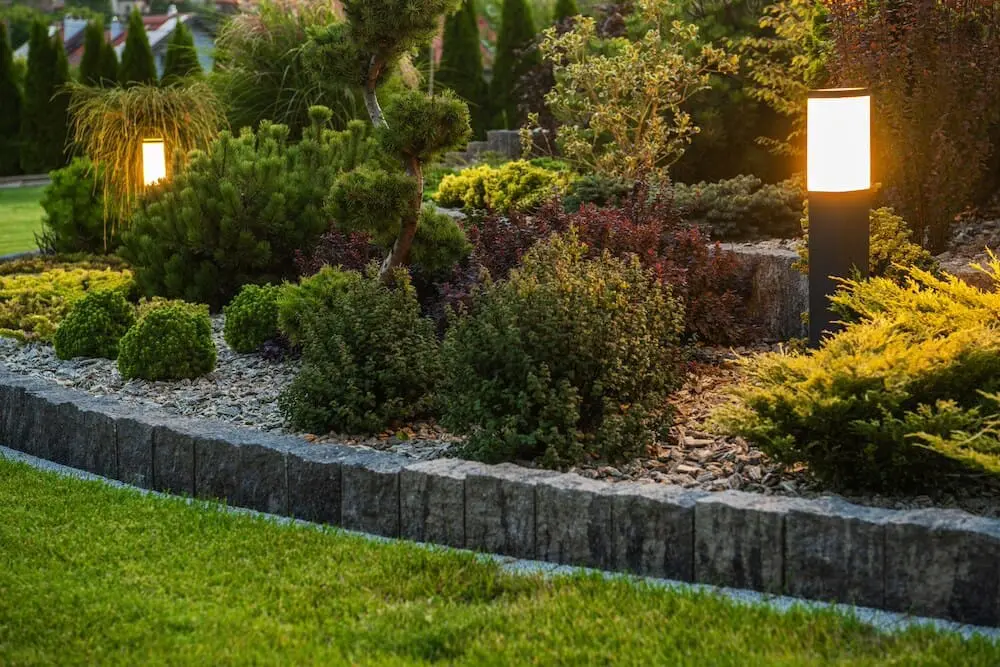
Pathway and step lighting uses low-level fixtures to define the walking surface without creating glare. The goal is to light the path, not the air above it. Recessed step lights and low bollard fixtures are the standard in luxury applications because they accomplish the task without drawing attention to themselves. A guest should be able to move through the space safely without consciously noticing the lighting that makes it possible.
Perimeter and entry lighting defines the arrival sequence and the edges of the outdoor environment. In a luxury setting this is not floodlighting. It is considered placement that creates a sense of welcome and security without flattening the atmosphere of the space. The approach to the property, the entry gate, and the transition from driveway to outdoor living area all benefit from deliberate perimeter lighting that reads as intentional rather than utilitarian.
The professional standard for safety lighting in a luxury outdoor environment: the light is noticed, the fixtures are not.
Lighting Ideas That Highlight Architectural Features
Architectural lighting is the layer that communicates the quality of the outdoor design after dark. It does for the hardscape and structural elements what daylight does naturally — reveals the material, the texture, and the craftsmanship. Without it, the investment in custom masonry, stone work, and built features becomes invisible the moment the sun goes down.
Uplighting for Structures and Stone Elements
Uplighting places the light source below the subject and directs it upward. It is the most widely used technique for emphasizing vertical elements in a luxury outdoor environment:
- Stone walls and retaining walls
- Structural columns and pergola posts
- Architectural facades and exterior wall planes
- Mature trees used as vertical anchors in the landscape
In a luxury outdoor setting, uplighting draws attention to material quality and craftsmanship. A well-lit stone wall communicates the same quality after dark that it does in daylight. A professional considers how the light will read from multiple vantage points — from inside the house looking out, from the main gathering area, and from the approach to the property — before finalizing fixture placement and beam angle.
Wall Grazing for Texture and Depth
Wall grazing places a fixture very close to a surface and directs light across it at a sharp angle. The result is a pattern of shadow and highlight that brings surface texture to life. It is particularly effective on:
- Natural stone and custom masonry
- Brick and rough plaster
- Textured concrete and board-formed surfaces
This technique only works on surfaces with genuine texture. On a smooth surface it produces flat, uninteresting light. On a custom masonry wall or a natural stone feature it produces depth that cannot be achieved any other way.
Wall grazing is one of the techniques that most clearly separates a professionally designed lighting system from a standard installation. It requires precise fixture placement and the right beam profile. It is not achievable by simply adding more lights to a surface.
Outdoor Lighting Design Ideas for Ambiance and Atmosphere
Ambiance lighting is the layer that determines how the outdoor space feels after dark. Safety lighting makes the space navigable. Architectural lighting makes it beautiful. Ambiance lighting makes it livable. This is the layer that guests feel without necessarily identifying — the warmth, the enclosure, the sense that the space was designed to be experienced at night, not just during the day.
Canopy and Tree Lighting
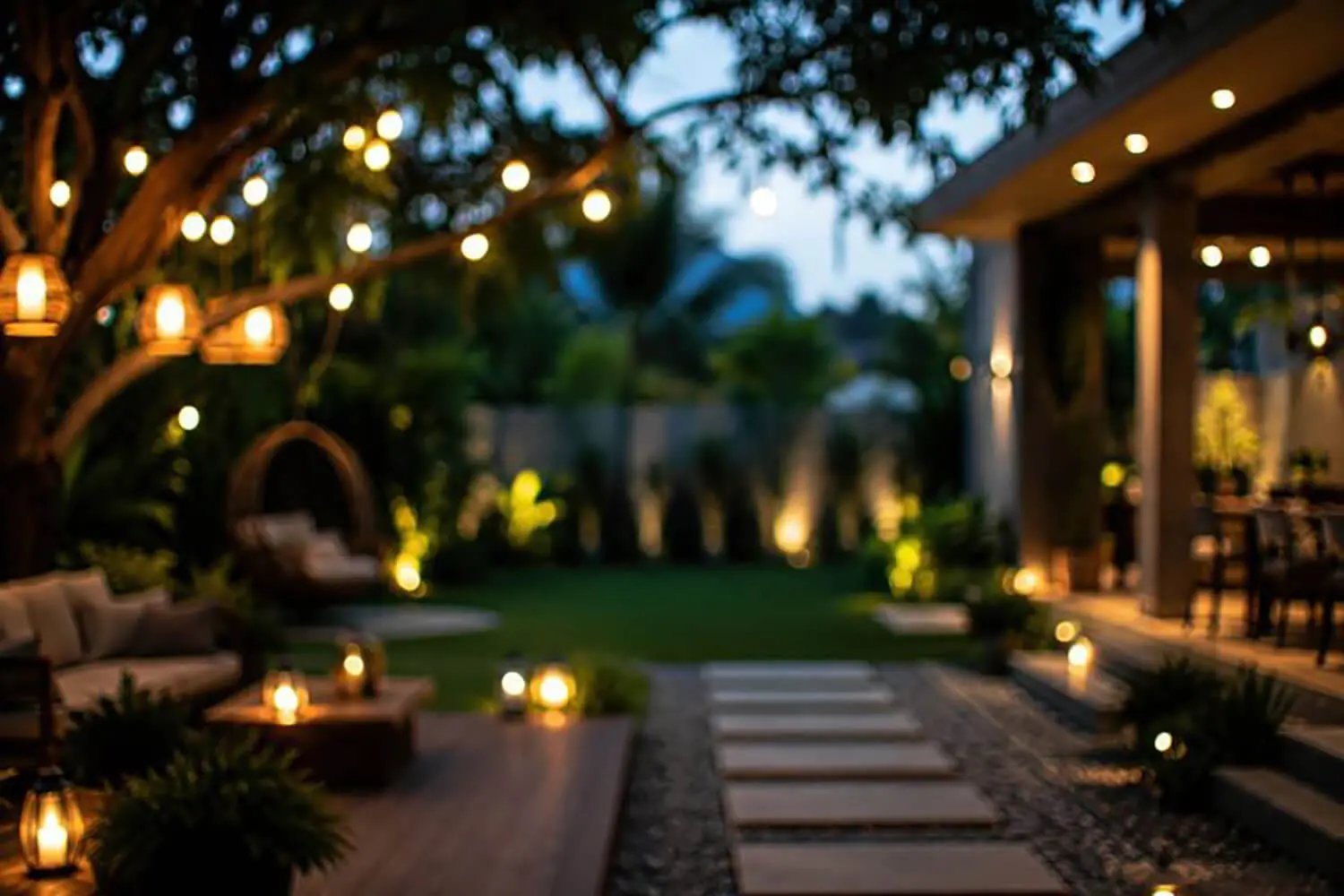
Canopy lighting places fixtures in the upper structure of mature trees to cast light downward through the foliage. The quality of light this produces is unlike anything achievable from a ground-mounted fixture. It is organic, layered, and variable in a way that feels natural rather than installed.
On a Napa Valley property with established trees, canopy lighting is one of the highest-impact techniques available. It creates a sense of scale and enclosure that makes an outdoor space feel like a room. The tree canopy becomes a ceiling, and the light filtering through it becomes the ambient source for the zone below.
Moon lighting is a variation worth noting. A single fixture mounted high in a tree and aimed straight down simulates the quality of natural moonlight. On large properties with significant tree cover, a few well-placed moon lights can illuminate an entire outdoor zone with a subtlety that no other technique matches.
Water Feature Lighting
Water features respond to light differently than any other outdoor element. A submersible fixture illuminates the water from within, creating glow and movement that changes with the surface. A surface-directed fixture creates reflection and plays light off the surrounding hardscape and planting.
The goal in a luxury setting is to make the water feature readable and beautiful after dark without making it the only thing visible in the space. Both light intensity and color temperature matter here. Warm white light in the 2700K to 3000K range integrates well with the rest of the lighting environment. Cooler temperatures can make a water feature feel isolated from its surroundings.
Over-lighting is the most common mistake in water feature lighting. A professional calibrates the intensity so the feature contributes to the overall composition rather than dominating it. The water should draw the eye without pulling it away from everything else.
Dining and Gathering Zone Lighting
Gathering zones require a different quality of light than pathway or architectural applications. The goal is warmth and enough visibility to see faces and food comfortably, without the harshness of overhead task lighting.
Techniques a professional uses in outdoor dining and gathering zones:
- Pendant fixtures suspended over outdoor dining tables for direct, intimate light over the surface
- String lighting integrated into pergola structure or overhead framework for diffused ambient coverage across the zone
- Low-level perimeter fixtures at the edges of the gathering space to define the boundary without adding brightness at eye level
Color temperature is the most important technical decision in this zone. Warm white light in the 2700K to 3000K range is the professional standard for outdoor dining and gathering. Cooler temperatures read as clinical and work against the atmosphere that the rest of the lighting design is building toward.
How Professionals Layer Outdoor Lighting for Luxury Landscapes
Understanding what each layer does is one thing. Understanding how a professional combines them is what produces the finished result.
The sequence matters. A professional starts with the safety layer because it defines the structural logic of the design. Pathway, step, and perimeter lighting establish where light needs to exist before anything else is considered. Once that foundation is mapped, the architectural layer is positioned in relation to it. Uplighting and wall grazing are placed so they complement the safety lighting rather than create competing focal points or wash out the lower-level fixtures.
Ambiance lighting comes last. It fills in the atmosphere between the functional and architectural elements and determines how the space reads as a whole after dark. By the time the ambiance layer is placed, a professional knows where the light already exists and where the gaps are. The ambiance layer resolves those gaps without adding light for its own sake.
The spatial dimension of this process is what most distinguishes professional lighting design from standard installation. Each layer operates at a different visual plane:
- Safety lighting works at ground level
- Architectural lighting works at mid-level and vertical surfaces
- Canopy and tree lighting works at the upper plane
A professional thinks in all three planes simultaneously. The result is a lighting environment that feels complete and dimensional rather than flat.
Bringing Your Outdoor Lighting Design to Life
Outdoor lighting design ideas for luxury landscapes work because they are designed as a system. The individual techniques — uplighting, wall grazing, canopy lighting, zone lighting — are only as effective as the thinking that connects them. A layered approach planned around the specific property is what produces a result that feels designed rather than assembled.
The right lighting design is different for every property. The existing trees, the hardscape features, the architecture of the home, and how the outdoor space gets used all shape what the design requires. There is no standard solution because there is no standard site.
At Keystone Yards, we design outdoor lighting systems built around the specific conditions and character of each property. If you are ready to explore what professional lighting design could do for your outdoor space, contact us today to start the conversation.